

Cloves for toothache by Ruth Ridley
25th January 2017
Using cloves as an anesthetic
My husband had toothache a few weeks ago, and while he awaited his appointment at the dentist, he resorted to local application of an occasional drop of the well-known anesthetic, clove oil. At the same time, I had a sore throat and asked if it could help that too. He looked it up on the internet and told me I could gargle with two drops of the oil in a cup of warm water. This gave me a pleasant fresh taste in my mouth and a mild, short-lived numbing effect. Do be aware, though, that clove oil should only be used diluted and in small quantities.

Cloves contain Eugenol
Eugenol is the active ingredient in clove oil, and can also be found in spices such as nutmeg and cinnamon as well as the herbs basil and bay. It acts as an analgesic by blocking nerve conduction and has various other properties including as an antibacterial [1].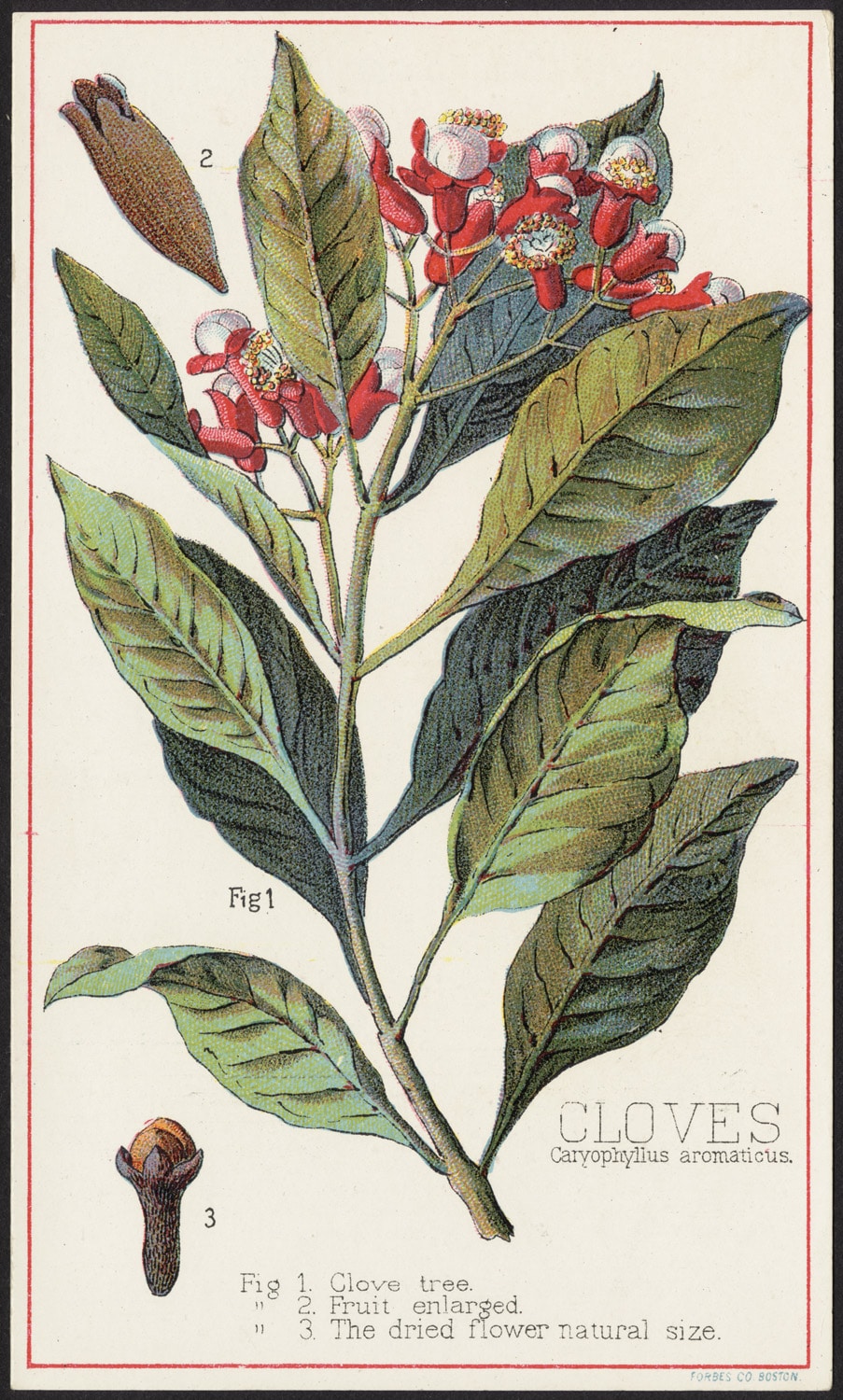
This picture of a clove plant was sourced from Boston Public Library on Flikr – a great resource for free vintage images.
The botanical name of the clove plant is Syzygium aromaticum. The plant is an evergreen which is native to Indonesia, and it is the dried flower bud which is used as a spice, although the stem and leaf also contain significant quantities of the active compound eugenol.
Antibacterial properties of cloves
The antibiotic nature of cloves can be attributed to the presence of eugenol, although other phytochemicals are of course present in the spice. It is possible that the relatively long shelf-life of spiced food may be an indicator of this germ-killing effect. Eugenol has been found to work by disrupting bacterial cell membranes [2]. There has been decades of work on the possibility of using various herbs and spices including cloves for use as antibiotics [3]. Work has been carried out to evaluate essential oils from spices for targeting resistant antibiotics for some time and there is some evidence to show that combining particular herbs and spices may have a particularly good effect [4].
Possible Future Uses of Spices as Antibiotics
There is currently an international race to beat antibiotic resistance. Going back to nature is one route that scientists are pursuing to find new ways of beating bacteria. Additionally, poorer countries may prefer to find natural, non-patented medicines which are likely to be cheaper than manufactured ones. However, because cloves can be an irritant, causing sensitization with repeated exposure, and are poisonous in larger doses, their usefulness may be limited.Clove Oil Cautions
As mentioned above, clove oil should be used diluted and sparingly. As with many essential oils and medicines, it is poisonous in large quantities, and repeated use can result in sensitization. If you have dental discomfort, see your dentist as soon as possible. Do not use if pregnant.Scientific References for the use of Eugenol and Clove Oil
[1] Advances in Pharmacological Research of Eugenol, Xiaojun KONG, Xiwang LIU, Jianyong LI, Yajun YANG, Curr Opin Complement Alternat Med 1:1, 8-11; January/February 2014
[2] The proposed mechanism of bactericidal action of eugenol, -terpineol and -terpinene against Listeria monocytogenes, Streptococcus pyogenes, Proteus vulgaris and Escherichia coli, S. O. Oyedemi*, A. I. Okoh, L. V. Mabinya, G. Pirochenva and A. J. Afolayan, African Journal of Biotechnology Vol. 8 (7), pp. 1280-1286, 6 April, 2009
[3] Bioactive Volatile Compounds from Plants, Editors: Roy Teranishi, Ron G. Buttery, Hiroshi Sugisawa, American Chemical Society Symposium series, Volume 525, April 06 1993
[4] Antibacterial Activity of Plant Extracts and Phytochemicals on Antibiotic-resistant Bacteria, Gislene G. F. Nascimento; Juliana Locatelli; Paulo C. Freitas; Giuliana L. Silva, Braz. J. Microbiol. vol.31 no.4 São Paulo Oct./Dec. 2000
Written by Ruth Ridley