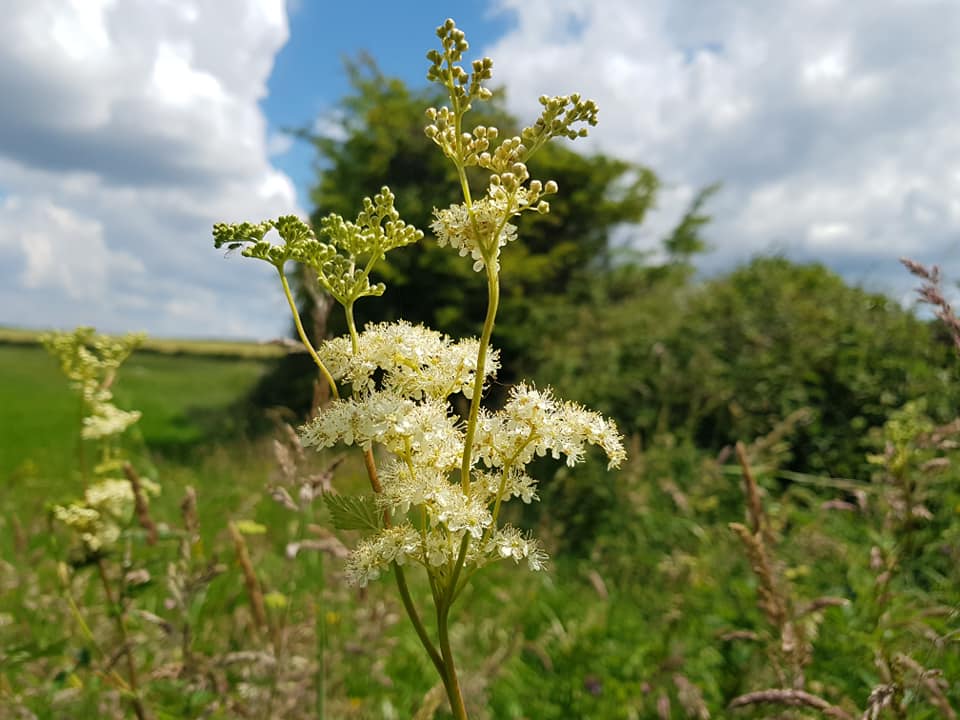
Meadowsweet: Sweet scent of summer and bringer of joy!
8th August 2025
Words by Vivienne Campbell of the Herbal Hub
Meadowsweet, Filipendula ulmaria
Meadowsweet is usually in flower for the two summer months of July And August. If you are lucky enough to have it growing near you then you might be able to pick some yourself and use it but, don’t worry if you don’t have access to the fresh herb because it’s easy to buy if from a dried herb supplier and use this to make extracts instead. You don’t need to do everything yourself.
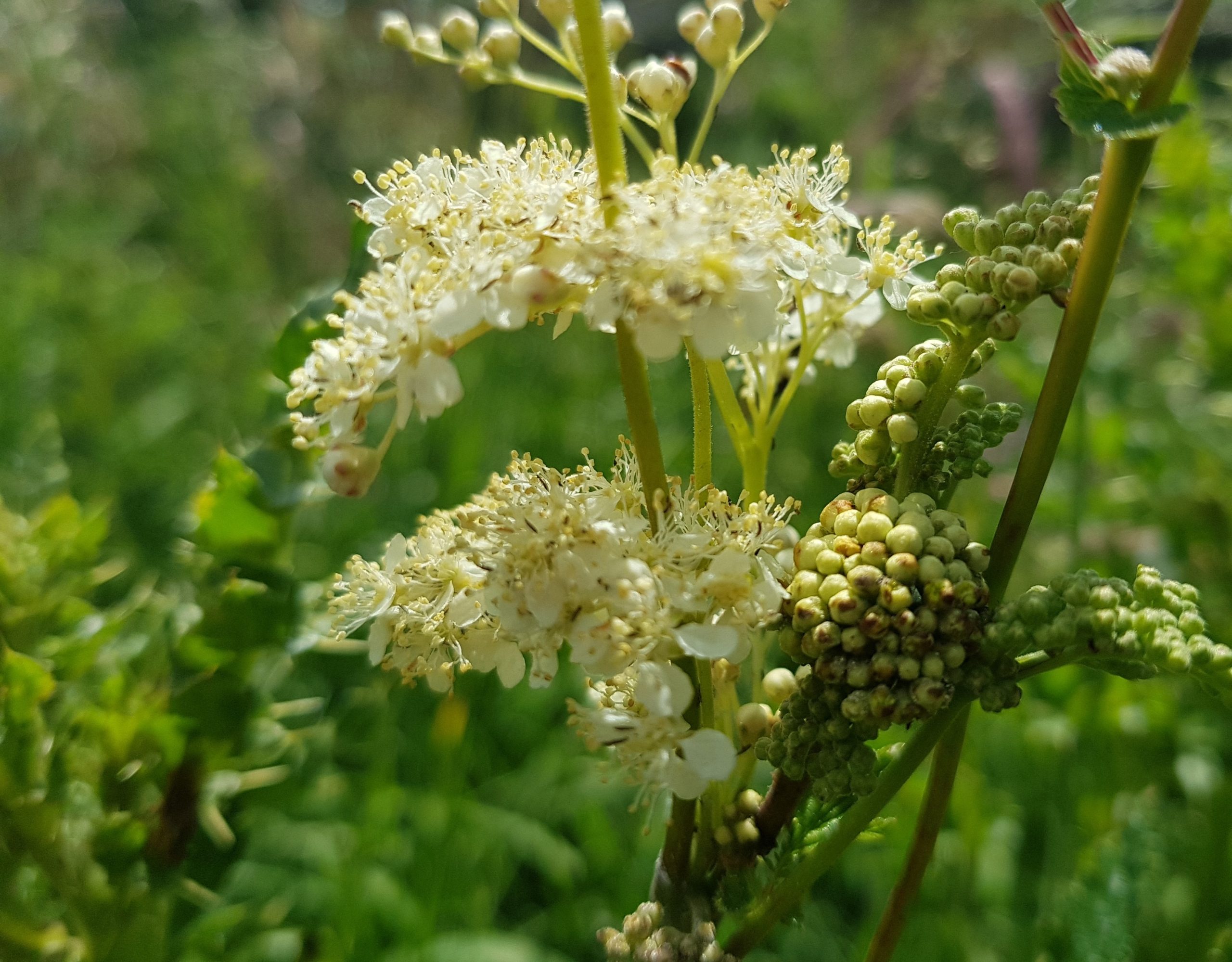
Identification
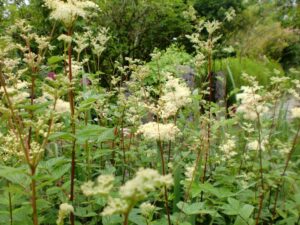
This plant grows in damp ground so it is common in ditches and fields that are a bit water-logged. It has beautiful, creamy plumes of deliciously sweet-scented flowers.
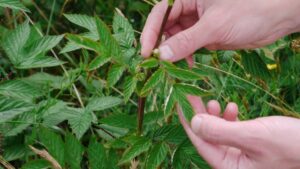
The leaves are distinctive, with this silvery colour on the back of them.
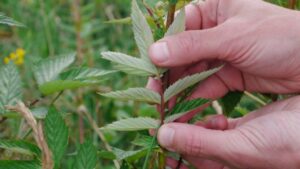
Please be cautious when trying to identify plants in the wild. There are lots of wild white flowers, and some of them are poisonous. If you’re attempting to try to identify a plant in the wild, please pay attention and make sure that all the bits match with the ID features: number of petals, shape of petals, shape of leaves etc. There are lots of plants with white flowers and they are not all friendly so make sure that you don’t harvest those in error.

The sweet smell of meadowsweet is a key clue to helping to find it but I can’t share that with you in blog! If you are new to this, then just start by observing rather than using. And instead you can simply buy dried meadowsweet from a herb supplier: that way you won’t poison yourself in error!
When to pick herbs:
We need to wait for a dry spell of weather if we want to harvest herbs to make anything other than fresh extracts.
What to do during wet weather:
Unfortunately rain and water will cause a lot of herbal extracts to go off or grow mould. So, what can we do with herbs during this wet weather? We can still use them to make fresh herbal tea because they are going into water in these anyway. With meadowsweet, simply pick some fresh flowers and the young leaves from higher up the plant, pop them into a pot, pour on boiled water, let it infuse for 5-10 mins, strain off the herb and drink the liquid. I like to add in other seasonal herbs such as lemon balm, camomile and roses. Meadowsweet is a natural antacid. To make a soothing digestive tea, try combining it with mint, camomile and fennel.
HANDY TIP: You can use herbal tea bags if you don’t have these herbs fresh in your garden. I just tear open the tea bags (e.g. peppermint tea) and pour the herb into the pot with the fresh meadowsweet and make the tea as normal (i.e. pour on boiled water, infused for 10 mins, strain etc.).
Herbal Footbaths can also be made with herbs when they are a bit damp from the rain (they can be made when it’s dry too of course). I love herbal footbaths! They are so aromatic, relaxing and soothing. Get a clean basin or bucket to use as a footbath. Put some sprigs of fresh meadowsweet into it (also lovely with some rose petals too), pour on hot water, adjust the temperature to one that is comfortable for your skin, pop your feet in the basin and relax for 15 mins or so. Make your skin extra soft by adding in a dash of a carrier oil (e.g. almond oil, coconut oil etc.), herbal infused oil or a few crumbs of cocoa butter or shea butter.
Extracts to make during dry weather:
This is the time to collect herbs and dry them. Drying herbs preserves them so that we can use them whenever we need to e.g. in the winter when they are no longer growing. Dried herbs can be used to make lots of extracts including teas, tinctures, poultices etc. My favourite way to extract meadowsweet is to make an infused oil.
Meadowsweet: The original source of Aspirin
Did you know that Aspirin not only comes from but is actually named after meadowsweet?
Meadowsweet is the original course of salicyclic acid, better known as Aspirin. Back in the mid-1800s researchers at Bayer (a German pharmaceutical company) started to look at this plant because elderly people used to take it to relieve the aches and pains of rheumatism. The researchers discovered the anti-inflammatory chemical salicyclic acid and when Bayer patented the drug as ‘Aspirin’ they actually named it after meadowsweet because back then its Latin name was Aspirea (where I lived in the west of Ireland some local people still referred to meadowsweet as ‘wild spirea’).
When taken long-term and at the correct dosage, meadowsweet can help to reduce inflammation and ease some types of arthritis. It doesn’t work immediately like a drug would but when taken consistently it can gradually start to reduce the inflammation. I’ve had great results working with clients with arthritis when they put in the effort to use this long-term.
Meadowsweet is also a shining example of the difference between an herb and a drug when considering safety and side-effects. Because it is a blood-thinner, Aspirin is often prescribed to people to prevent strokes [This is a good thing! I’m not suggesting for a moment that people don’t take this], and they take this every day, indefinitely. However, over time Aspirin can erode and damage the lining of the gut and in extreme cases this can cause internal bleeding. That is a very serious side-effect and also an emergency, requiring urgent medical treatment. In contrast, as I’ve already mentioned, Meadowsweet is actually used as an antacid because it soothes and protects the digestive system. So even though meadowsweet contains salicylic acid, because it contains so many other chemicals and compounds they come together to create this protective and soothing effect on the digestive tract. Meadowsweet is a lovely example of how medicinal herbs tends to be beautifully balanced and more in harmony with our bodies.
My Favourite Extract: Infused Oil of Meadowsweet
Medicine for the body; Emotionally uplifting; Beautiful in skincare.
This is such a versatile extract to make. It’s rare to see it for sale in shops or from herb suppliers. Fortunately, it’s easy to make and keeps well, having a long shelf-life.
To make an infused oil, take the dried herb, put it in a clean dry, jar, cover it with a base or carrier oil [I recommend a neutral oil without a strong smell e.g. refined sunflower, almond, or peach kernel oil; don’t use something smelly like olive oil because it will over-power the scent of the herb].
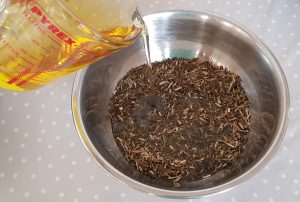
Put the dried meadowsweet into the jar. Pour on enough of the base oil to completely cover it. Label the jar with the name and the date you made it. Put it in a cupboard and leave it to infuse for 6 weeks [NOTE: I don’t recommend leaving it on a sunny window ledge because the light and heat make the oil go rancid quickly].
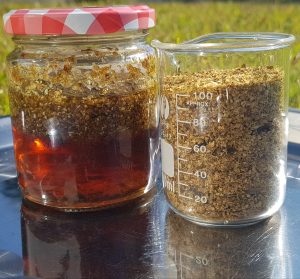
After 6 weeks strain the oil through some muslin [this is a type of cotton cloth and is available from fabric shops]. Pour into a clean dry bottle and label ‘meadowsweet infused oil’ with the date that you made it. Depending on the carrier oil that you used, this will usually keep for at least 18 months. The oil is now ready to use.
This oil smells divine! So sweet and so very special. It is safe to use undiluted on the skin [it is NOT an essential oil].
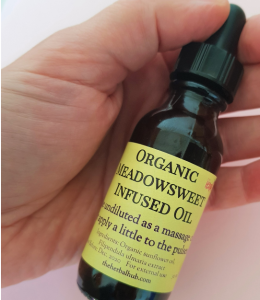
Ways to use meadowsweet infused oil:
*As an herbal remedy……
If you have a mild upset stomach then gently massaging this on to your tummy can sometimes bring relief. I discovered this when I had an upset tummy but had run out of both meadowsweet tea and tincture (silly me!): both my usual remedies in this situation. I tried applying the infused oil to my belly not expecting it to have any effect at all but much to my surprise it did. I was delighted and have used it this way since.
It is also being used in massage treatments to try to relieve different types of pain due to inflammation e.g. arthritis etc. I find it works well when combined with other herbal infused oils often used this way such as such as arnica or St John’s Wort.
*Soothing & uplifting for the mood and emotions….
Personally I love using this oil in this way. I find the sweet scent really helps to clear the head and uplift my mood. It is an aroma that I find optimistic and also kind and tender. Interestingly, so often over the years, when I’ve introduced people to this plant on herb walks, they lean in and smell it and many people have a gleeful smile on their face saying that it reminds them of their childhood [whether or not that would you make smile would probably depend on your childhood!!]. There seems to be something about this aroma that acts on the memory and transports some people back to that time. I do wonder if this is because I am in Ireland and so many people here spent their childhood holidays visiting relatives in the countryside where this herb is so prolific. I will need to test it on people in other countries to rule in or out this theory!

To make this oil easier to apply, I make it into a balm that I then apply to my pulses whenever I want to connect with its beautiful scent. I find this very handy to have and for me it really does help to melt away the stress and worries, restoring a brighter outlook.
Natural Cosmetics & Skincare
Meadowsweet is becoming popular in natural cosmetics. Obviously its beautiful scent is one of the reasons, but it blends so well into any topical skincare product that contains a carrier oil. I like to put it into body butters, facial serums, water-free creams and emulsions. It can be quite soothing for the skin and tends to suit most skin types.
Where to learn more about meadowsweet
Vivienne’s video courses are practical guides to making medicines, foods, cosmetics & extracts.
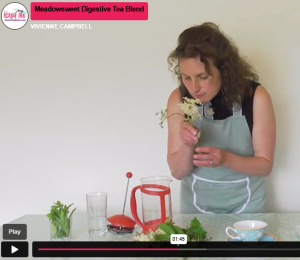
Learn about using meadowsweet as a wild food and herbal medicine, as well more info about how to identify it, in my video course
LEARN WITH THE SEASONS. This features a delicious meadowsweet cordial that’s easy to make at home, as well as a digestive tea blend.
Or learn how to use meadowsweet in natural skincare, including detailed step-by-step videos and instructions showing how to make herbal infused oils, a water-free cream and an emulsion made from various meadowsweet extracts (including an herbal glycerite) in this video course
NATURAL COSMETIC-MAKING AT HOME WITH HERBS
I hope that this has inspired you to try to connect with meadowsweet.
It truly is a very special plant and it’s just delightful to work with.
This blog/article is copyright Vivienne Campbell 2021 © and was updated in March 2025.
Safety note: The information in this article is for educational purposes only. It is not to be used to replace the advice and care of a qualified medical practitioner. If you are pregnant, breast-feeding, have a disease, a medical condition or taking any pharmaceutical medication (especially blood-thinners) then please do not take herbal medicines without first seeking suitable professional medical advice to confirm whether or not it would be safe for you to do so. Herbs can often help in these circumstances but this is better and more safely done by a professional.
ABOUT VIVIENNE
Vivienne Campbell BSc (Hons) MNIMH qualified as an medical herbalist in 2003 and has worked as an herbalist ever since, initially setting up her herbal medicine clinic in the west of Ireland. She teaches classes on herbal medicine, wild food foraging and natural cosmetic-making in Ireland, Portugal & the UK. She teaches worldwide via her online video courses and classes. She runs classes from beginners’ level to professional. She is a member of The National Institute of Medical Herbalists and The Association of Foragers. You can see more details on her website
https://theherbalhub.com/