
Key identifying features
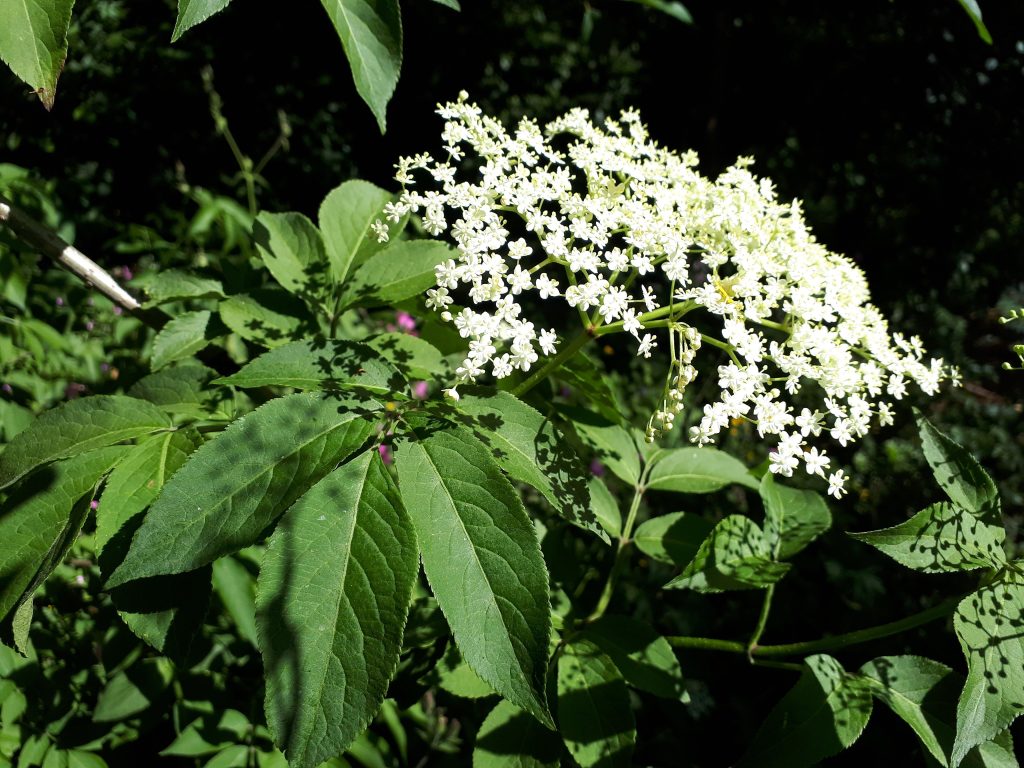
Elder is a shrub-like tree with crooked, brittle branches and rough bark. Its large compound leaves, typically with seven to nine leaflets, have a strong, somewhat unpleasant scent when crushed. In late spring to early summer, Elder produces flat clusters of fragrant cream-coloured flowers, which later develop into small black berries. The tree often hosts the Jelly Ear fungus (Auricularia auricula-judae) on decaying branches. Green parts of the plant—including leaves, seeds, bark, and twigs—contain amygdalin, a cyanogenic glycoside that is toxic if ingested raw but is deactivated by cooking.

Virtues
Elder has been treasured for centuries for both its medicinal and culinary qualities. Elderflowers are commonly used to soothe colds, relieve respiratory infections and encourage sweating. Infused, then made into a compress, the flowers can ease sore, puffy eyes and skin blemishes. Elderberries are renowned for supporting infection resistance and are often cooked into syrups, jams, wines, meads, and sweet dishes. Infused oil from elder leaves can be applied externally to soothe bruises, sprains, and chilblains. Even the pith inside elder branches has practical uses, historically employed as a soft cork for mounting botanical specimens or in craftwork.
Spiritually, Elder is associated with protection, health, and wisdom, and features prominently in European folklore. The Elder Mother, or Hyldemoer, is believed to inhabit the tree and is still honoured in Northern European traditions. Foragers are advised to seek her permission before harvesting, and Elder should never be cut or burned without this symbolic consent. Elder pith has been used to cork spell bottles, and leaf-infused oils feature in traditional magical preparations.
Note: Only consume Elderberries or flowers after cooking; green parts are toxic if ingested.
Growing
Elder grows readily in hedges, parks, and gardens, often forming dense thickets. It can be confused with Ground Elder (Aegopodium podagraria), which has similar foliage but is edible, or with Meadowsweet and Viburnum species, which may resemble flowers or berries.
Foraging/harvesting tips
For harvesting, flowers are best collected at Beltane/midsummer, berries from midsummer through Samhain, and leaves from spring to late summer. Elder is hardy and fast-growing, making it widely available, though proper identification and preparation are essential for safety.
