
Healing in Anglo-Saxon England
At the edge of the village, the wise woman collects her plants. She spends time connecting with each one, carefully selecting the plants that call to her. She has the patient, her child, and their illness in her mind as she gathers. In her mind, she speaks to each plant, telling it what help she needs. The plants wave at her in the gentle breeze, capturing her attention, as they let her know they are happy to be included in the healing ritual. She knows that all aspects of the mind, body and spirit must be included in the healing, in order to restore the balance, order and the return to wholeness or ‘hǣl’ in Old English.
In the early medieval period disease, or unhǣlu, could occur in a few different ways:
- Firstly, it could be an invasion of the body by something outside of it. This could be through poisoning, or infection – in the remaining medical manuscripts it is spoken of as venom. It could also be through attack by supernatural beings such as elves or night-walkers, a wound or something blocking or trapped in the body. As Louise Jolly (1996) shows, the treatment requires it to be removed or driven out of the body through things like purgatives, bloodletting or surgery.
- Secondly, unhǣlu can occur through depletion, exhaustion, the loss of barrier integrity or theft of vitality, health or soul. As Van Ardsall (2012) emphasises, the need to rebuild strength could be through nourishment, drinks or tonics, warmth, prayer and confession, or making a protective barrier, for example, by applying salves to the skin or with amulets.
- Thirdly, unhǣlu is a disorder of the state of balance or of wholeness, where the body no longer functions correctly. It could be through environmental exposure, for example wind exposure or being frozen, through divine punishment, fate, relational or societal breakdown, or an imbalance of humors. Although, as Cameron (1993) states, the Anglo-Saxons did not use humoral theory in the same way as Galen taught it, this came to Britain later. It was important to restore normal order and balance through herbs or prayer.
Magic and Medicine
In Anglo-Saxon medical ideology, these concepts didn’t necessarily work in isolation, but overlapped to compromise someone’s wholeness. The texts indicate that there was no distinction between ‘magic’ and ‘medicine’, and for many years this meant that research on early English medicine considered the latter as useless superstition. It has only been in the last few decades that these texts have been re-evaluated with the modern knowledge that the process or ritual around getting healing – being taken to hospital, taking a medicine, placing hope in a ‘professional’ person who speaks using obscure words – has a huge effect on the cure; it is now named the ‘placebo’ effect or ‘the power of suggestion’.
Research shows that mind-set or expectations to heal, similar to placebos, can trigger specific neurobiological correlates including the immune, cardiovascular, and neuroendocrine systems. In fact, placebos are driven in large part by the mind-set that the pill is effective (Crum, 2017). The research also shows that medicines are more effective when the physician tells the patient the benefits of it before or while administering it. This is fairly recent research, however, and it is possible that the inclusion of charms and rituals in healing were used specifically to create this mind-set and facilitate patient involvement in the healing. As Pollington (2000) points out “When we look at the many strands which make up Anglo-Saxon medical lore we will see that religion had come to play a large part in the practice of healing, and religious models in fact permeated mediaeval thought in much the same way that scientific ones now permeate ours.”
Anglo-Saxon Herbs
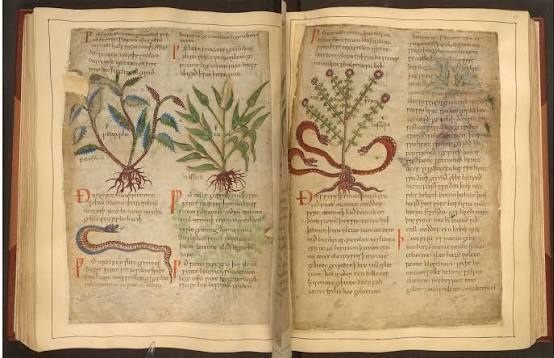
In the Anglo-Saxon medical manuscripts we find references to many herbs which were used in remedies, some which grew naturally in Britain, others were brought by the Romans and naturalised, and others still were imported via trade from great distances.
Herbs were gathered at certain times, on certain days, at certain moon phases all to enhance their potency but also to include ritual. The Anglo-Saxon’s didn’t practice ritual for show, they were practical people, and they did things because they worked.
We find many of our favourite plants in the herb books at this time – Yarrow, Plantain, Mugwort, Betony, Nettle, Rose, St John’s Wort, Sage, Rue, Oak, Marshmallow, Calendula, Hyssop, Hazel, Heather, Hawthorn, Fennel, Elecampane, and Elder to name just a few.
These herbs were used extensively as the main chemical part of medicine. They were used for their astringent or demulcent properties, to heal wounds, stop bleeding, to stop coughs or to calm nerves. The plants were central in the healing process, but they weren’t all of it, healing included the whole.
Today, a herbalist walks through her garden looking at the plants she has grown, the ‘weeds’ at the edges, some that other gardeners would decry. She acknowledges the healing properties in each as she carefully gathers her herbs. As she gathers, she thinks of the medicine she will create and the person she is aiming to help. Mindfully she harvests, putting each plant with care into her basket. Our concepts, descriptions and our language may have changed but our purpose, our care and the plants we harvest remain the same as 1000 years ago. We carry on this tradition rooting us to the land and our ancestors.
References
Louise Jolly, K. (1996). Popular religion in late Saxon England : elf charms in context. Chapel Hill (N.C.) University Of North Carolina Press
Cameron, M.L. (1993). Anglo-saxon Medicine. New York: University of Cambridge.
Crum, A. and Zuckerman, B. (2017). Changing Mindsets to Enhance Treatment Effectiveness. JAMA, [online] 317(20), p.2063. doi:https://doi.org/10.1001/jama.2017.4545.
Van Arsdall, A. (2012). Medieval Herbal Remedies The Old English Herbarium and Anglo-Saxon Medicine. Routledge.
Pollington, S. (2000). Leechcraft : Early English charms, Plant lore, and Healing /. Norfolk: Anglo-Saxon Books.
Thanks to ambassador Rox Madeira for providing this content. Rox is a historical and community herbalist and ambassador for The Herb Society. Her work sits at the intersection of historical herbalism, women’s healing traditions, embodied restoration, community care, decolonial perspectives on plant medicine, and the role of plants in restoration, memory, and belonging after rupture. She runs foraging walks, women’s seasonal circles and an online learning: Wise Herbal Ways as ways to reclaim lost ancestral knowledge, to reconnect with ancestral land, our plant kin, to see into the ‘sea of green’, to look a new at the rebel weeds and learn from their tenacity, to encourage us to look after our environment, and reclaim the knowledge of the wise women. She has a podcast ‘The Sage’s Cabin’.