
Key identifying features
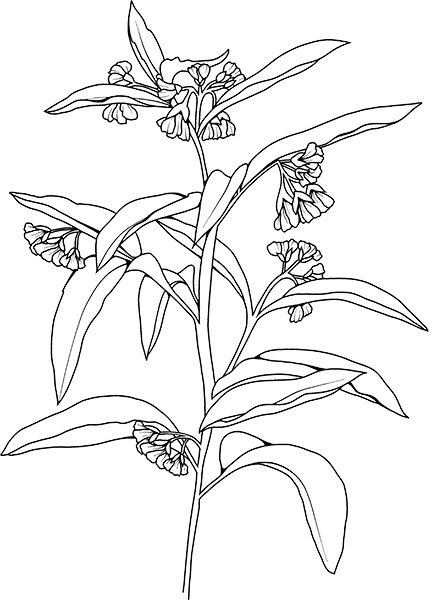
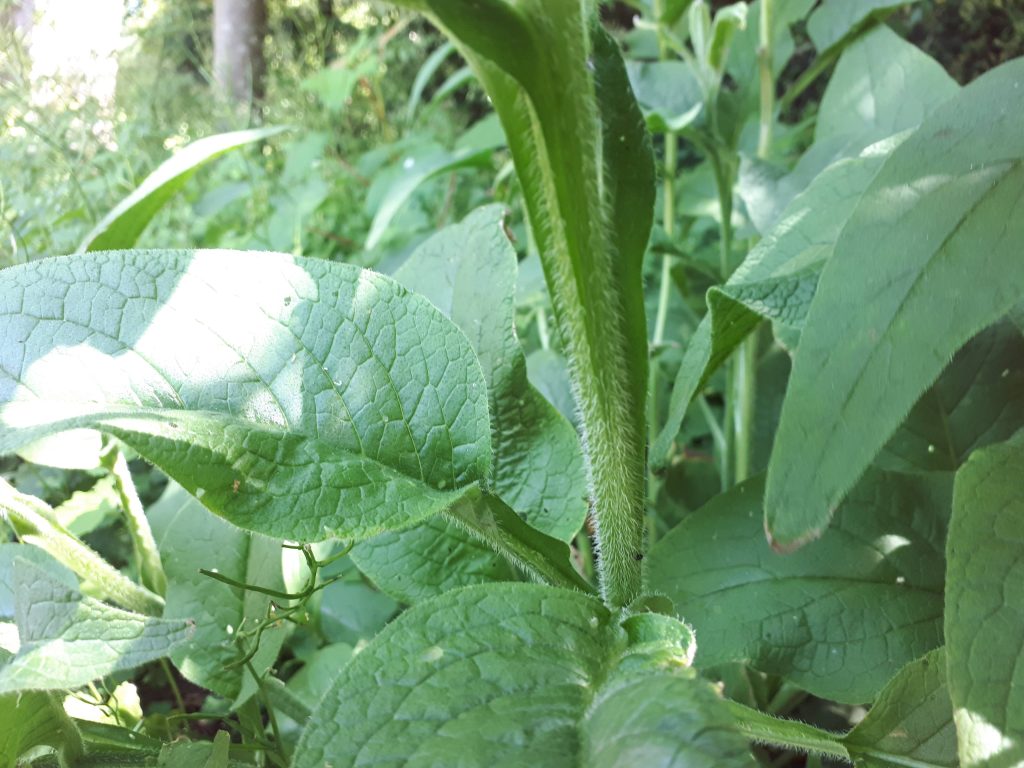
Comfrey is a robust herbaceous perennial with large, hairy, heart-shaped leaves and clusters of drooping, bell-shaped flowers in shades of white, cream, pink, blue, or violet. The leaves and stems are rich in mucilage, giving them a slightly slippery texture when crushed. Several species are found in towns and countryside alike — some tall and upright, others forming dense ground cover. Common Comfrey (S. officinale) and Russian Comfrey (S. × uplandicum) are the most frequently encountered.
Comfrey thrives in damp soil along hedges, riverbanks, and waste ground. It is a wildlife-friendly plant, beloved by bees and other pollinators, and provides shelter for small animals.
Virtues
Comfrey is one of the great traditional healing herbs. Its name comes from the Latin confervere, “to grow together,” referring to its long use in supporting the repair of bones, tissues, and skin. The leaves and roots contain allantoin, mucilage, and other soothing compounds that encourage the regeneration of cells.
Externally, Comfrey is used in poultices, ointments, or infused oils to help with bruises, sprains, minor wounds, and to support recovery from muscular or ligament strain. It is suitable only for use on unbroken skin. Internally, Comfrey was once eaten or taken as tea or cooked greens, valued for its mild, cucumber-like flavour and nutritive qualities. However, modern safety guidance restricts internal use due to the presence of pyrrolizidine alkaloids (PAs), which may be toxic to the liver.
Beyond its medicinal virtues, Comfrey enriches the soil. Its large leaves draw up minerals and nutrients from deep underground, and when used as mulch or in compost teas, they return this fertility to the topsoil – a gift for gardeners and permaculturists.
Spiritually, Comfrey is associated with deep healing, restoration, and the mending of what has been broken. In magical practice, it supports reconciliation, rebuilding trust, and grounding after times of turmoil. It carries a gentle, steadfast energy that encourages resilience and renewal.
Growing and/or foraging/harvesting tips
Comfrey grows readily in gardens, hedgerows, and neglected land, especially in damp, fertile areas. It often appears in urban plantings, with Creeping Comfrey (S. grandiflorum) used as an ornamental ground cover, while Russian and Common Comfrey varieties are popular in community and wildlife gardens for their ecological value. Harvest foliage from spring through autumn by snapping off individual leaves cleanly. Allow flowering stems to remain for pollinators. Leaves can be hang-dried for herbal use or added fresh to compost and mulch for the garden. Comfrey is abundant and not endangered, but harvesting should always be moderate to maintain healthy stands.
Caution: When foraging, take care not to confuse Comfrey with Foxglove (Digitalis purpurea), which is poisonous.