
Sage Advice
12th September 2024
Herb Society member Ronnie got in touch with the blog to ask about her sage plant.A simple question
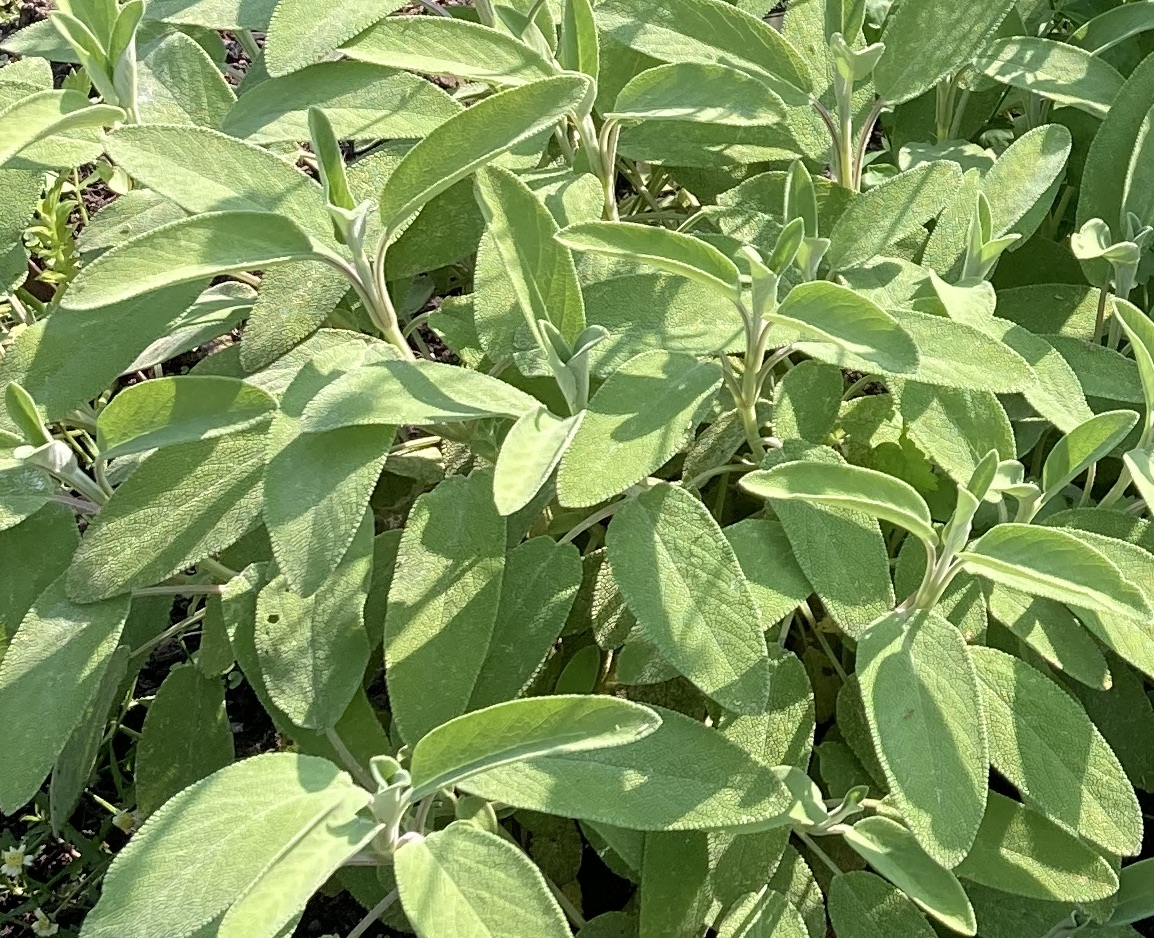
I have a large sage plant which has been badly treated over the past two years it has been routinely blown away i.e., uprooted and tossed along the garden path by freakish storms and gales we have encountered. Each time I repotted it and it just continued to grow after the last time I planted it into my raised bed and the huge problem now is that I have too much to eat but I am loathe not to utilise the beautiful leaves this plant provides so what can I do with it all ideas please? Also the plant has spread outwards but is low growing can I train it to a bushier shape and can I split the plant safely to give to friends I want to keep this plucky little plant going but I am really limited on space. The plant is a couple of years old so can I keep it growing or should I start anew? A lovely question so here’s a little bit about sage, the Mediterranean plant that’s happy in our British gardens, even with a little buffeting.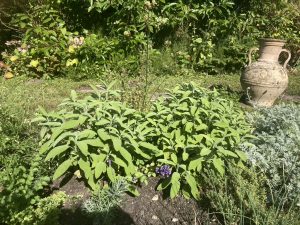
Plucky little plant
It’s clear that this sage wants to be in Ronnie’s garden, which is good news for her, there’s a belief that the owner’s business will prosper or fail just as the plant thrives or withers. And it’s also said that where the wife rules the sage grows vigorously. Sage is also considered a symbol of domestic virtue – I’m not sure if that’s connected! Sage certainly has much to offer. To quote John Evelyn: ‘’Tis a plant, indeed, with so many and wonderful properties as that the assiduous use of it is said to render men immortal’. Perhaps a claim that would have advertising standards quaking today, but drawn presumably from the medieval proverb ‘The desire of sage is to render man immortal’ which echos the Chinese proverb ‘Why should a man die whilst sage grows in his garden?’, acknowledging its reputation for healing. Personally I’m happy to go by the phrase: ‘(S)He that would live for aye, Must eat Sage in May’ Sage appropriately shares its name with the moniker for a wise elder as it is considered to be good for the brain, the senses and the memory – it steadies nerves, sharpens wit and stimulates the brain. Don’t forget to have your sage tea, and while you do, remember that in the 17th Century the Chinese would trade three chests of tea for one of sage leaves, such did they price it. Collecting sage is an important cottage industry in Dalmatia. Sage honey commands the highest price there.Taking care of sage
Sage will keep going for a number of years, it’s considered hardy and will make it through most our winters, perhaps with a little fleece or a cloche for protection against the harshest elements. It is best replenished after about four or five years by cuttings or layering. Take cuttings (from softwood) in later spring or early summer or layer in spring or autumn (take a woody stem, remove the leaves on a section and pin down into the soil, cover with soil and label, check in spring for autumn layers, or after 8-10 weeks for spring layers, and, if there are new roots formed, snip the branch away from the mother plant and pot up, then grow on in a cold frame for a year before planting out. New plants are great to share with friends, or perhaps they’d appreciate bunches of fresh or dried leaves. To dry the leaves, hang bunches upsidedown, or use a dehydrator. It can be tricky to retain the flavour, check that the sage does not smell too ‘musty’ after drying. Best time to ‘shape’ the plant is in summer, after flowering when you can cut it back, but be careful about going into the older woody parts, unless you leave leaf buds it will not grow back. However with many herbs we affect growth by where we pick the leaves we use. Taking from the sides could encourage more top growth to keep it compact. Don’t prune sage in autumn as this many kill the plant.Sage taking care of you
There are more than 900 species of Salvia (including rosemaries under their new classification), the ‘common’ variety is Salvia offinalis. ‘Officinalis’ of course telling us this is the medically used herb, and ‘Salvia’ confirming its medicinal use as name is derived from the latin salveo or ‘I heal’.Sage for the mind
I’ve already mentioned sage tea, it’s considered beneficial for the mind, and cooling for hot flushes (take a small cupful a couple of hours before bed to reduce night sweats). Leaves picked before flowering have a milder, warmer flavour than those after flowering which are stronger with more tannin flavour. You can flavour the herb tea with grated lemon zest and honey, in Jamaica lime juice is the favoured accompaniment to sage tea.Sage for digestion
Sage tea is considered a digestive, it can help ease flatulence and is also used for an upset stomach or diahorrea.Sage for the skin
Drying sage can be used in facial steams and astringent cleansing. It makes a good toner or face pack to close large pores and can help with dry skin when macerated in an oil, such as sunflower oil. This could also be added when making creams for cold sores or embrocations for rheumatism as sage is beneficial in both these applications. A sage lotion can be used for raw skin and ulcers and an infusion of sage in milk can be used for sore eyes or to relieve itching.Sage for hair
A sage rinse is as good as rosemary for darkening grey hair and is also recommended to treat dandruff.Sage for teeth
Sage is a traditional ingredient in tooth powders and a basic toothpaste could be made by choppnig sage and salt together then rubbing onto teeth with a piece of cloth. Sage is also good as a gargle for sore throats or gum infections and mouth ulcers (perhaps adding a little Apple Cider Vinegar). Culpeper references a gargle made with sage, rosemary, honeysuckle and plantain boiled in wine or water with honey.Sage for the home
Pungent sage is good dried in pot pourri and makes an attractive addition to tussie mussies. Leaves can be put among linen to discourage insects. Burning sage leaves on embers or boiling them in water can help disinfect a room; and sage smoke deodorizes animal and cooking smells.Tasty sage
When you’re cooking with sage it’s helpful to remember this personification from a chef: ‘In the grand opera of cooking, sage represents an easily-offended prima donna. It likes to have the stage almost to itself.’ So chose your dish to allow you to simply enjoy the sage, not too much fuss. Here are a plethora of simple ideas for cooking with sage, you will surely be able to try at least one of them:- Add sage to an omelette, or incorporate with stewed tomatoes
- Warm apple juice with sage, or add the leaves to fruit cups and other summer drinks (sage is one of the herbs used in vermouth)
- Sage is great to flavour oils, butters and vinegars or make a jelly, so you have its pungency ready to pep up any meal.
- Dried, powdered sage leaves can be scattered over food in the way you might use pepper
- Toss sage butter into pasta.
- Blend sage leaves or sage and onion stuffing with cream cheese as a sandwich filling (when you make the stuffing, double up measurements and freeze half for later use, or to add to soups)
- Make herb scones, or oatcakes (recipe below)
- Or simply do as they did in medieval times and eat sage leaves on buttered bread.
Sage and cheese
Sage is credited with improving the flavour in cheesemaking. A poem by Gay references the sage:‘Marbled with Sage, the hardening cheese she pressed.’
Living in Gloucestershire, I’m inspired by the labour that went into creating colourful cheeses in my local area. Here’s a description from 1845:“A couple of handful of sage leaves and a handful of parsley are put into a portion of the evening’s milk and suffered to remain all night. In the morning, the milk is warmed and, after being strained from the leaves, it is turned to curd with the rennet in the usual way. In the mean time a portion of the morning’s milk into which no colouring matter is put, is turned to curd by rennet; and the curds of both kinds are kept separate through the process of draining and scalding, till they are ready to be put into the vat, when they are mixed according to the a fancy of the dairymaid. Sometimes the green curd is pressed into a tin or wooden mould, so as to form a dolphin or some other fanciful figure; in which case it is taken carefully out of the mould, and put into the vat withtout breaking it, and the white curd is crumbled between the fingers and pressed carefully and firmly round it. In other cases the sage and parsley leaves are only bruised, and the juice which is pressed from them is mingled with a portion of the morning’s milk; or one portion of the milk is coloured red with the juice of beetroot and another with the juice of spinach leaves flavoured with sage, and another yellow the bruised petals of marigold … In other cases the whole of the milk is coloured and flavoured with sage.”
