
Spagyrics – The Forgotten Herbal Remedies
20th October 2025
Words by Hannah Charman MNIMH MGHR
It’s been a very long time since I qualified as a Medical Herbalist. Since then I’ve grown to love my work more than ever, but there have always been a few aspects that didn’t quite add up to me. One was that we’re taught that we use‘the whole herb for the whole person’Yet when we make a tea or a tincture, we throw the herbs onto the compost heap afterwards. I wonder what constituents, vitamins and minerals are we wasting when we do that?
Finding the whole picture
Once someone asked me if I use Bach Flower Remedies in my medicines. I’ve never used them because to me it seems odd to add in a whole different plant to work on the patient’s energy body. Surely the herbs already in the mix should be able to do that too? The way we were taught to work with patients likewise didn’t feel holistic enough. I did a BSc course in western herbal medicine, which was very heavy on the science. After four long years of learning plant constituents and human physiology, there was little sign of the true essence of our craft. When I came home from my travels soon after qualifying, I found myself at a low point, and someone took me to an Astrology evening class in an effort to cheer me up. I was immediately hooked! Here was a system which helped me to understand myself, my family, friends and enemies better. I could see how we each fitted into the complex web of the universe, and that there was divine timing behind everything. Years later, I went to another talk on medical astrology. When each astrology chart was presented on the screen, nothing was said about the patient or case it related to. The more experienced medical astrologers had to work it all out from the chart, and they were spot on every time! It felt as though pieces of the jigsaw were slowly slotting into place. I went on to start the Plant*arium Herbal Astrology course, which gave me yet more insight, but it still felt as though there was a missing link. Then, quite by accident, I discovered spagyrics.Spagyrics
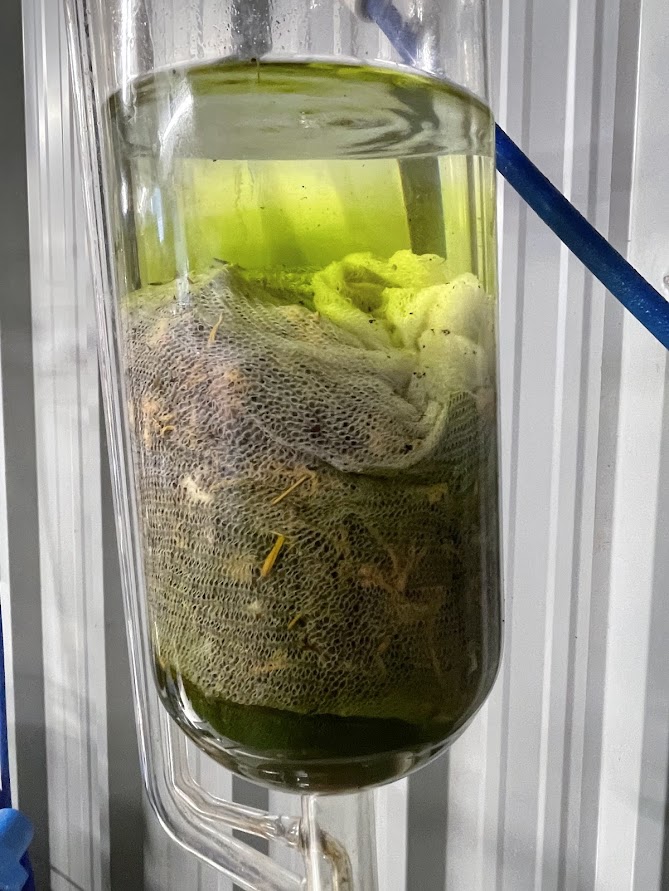
The Greek word ‘Spagyric’ literally translates as ‘to separate and reawaken’. It’s a very old alchemical way of creating powerful herbal medicines. Alchemy is an ancient art of transmutation, where one substance is refined into a higher one. With spagyrics, the herb is separated into 3 parts:- Soul (Sulphur element) is extracted by water distillation. The soul of the plant will work on the soul of the person when they take the finished essence.
- Spirit (Mercury) is traditionally extracted by fermentation, hence why alcohol is referred to as ‘spirit’. Spirit is more akin to the subconscious mind, and is associated with the planet Mercury.
- Body (Salt) is extracted by burning the used plant material (marc) to ash, and then crystalising the ash into mineral salts. Instead of being discarded, all the nutrients in the plant are returned to create a potent, holisitic medicine.
Making essences
Once the herb is harvested, the essential oils are distilled off to separate the sulphur (soul) of the plant. The first part of the separation is complete once we have a hydrosol, or aromatic water from the plant. Since each person has their own unique soul, each plant does too. The profile of aromatic or volatile compounds will be unique according to species, soil conditions, stressors, climate and how it’s grown.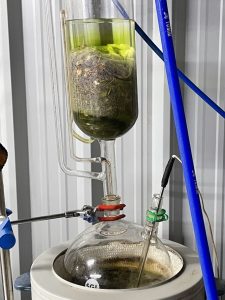 Next the marc would traditionally have been fermented for around 40 days, although some manufacturers tincture their marc to save time. Assuming the marc is fermented, it gives off alcohol or, as Herbalist Sajah Popham puts it, the plant ‘gives up its ghost’. This is the spirit of the plant which will work on the spirit of the person.
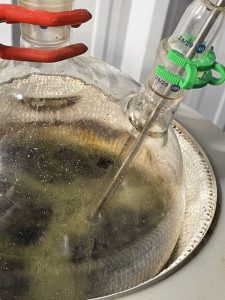 Finally, the marc is pressed, dried and incinerated to ash. The ash is then burnt again to form crystals rich in plant salts, vitamins and minerals. This is known as the ‘Salt of Salt’, but with essences, the fermentation residue is also crystalised to create a ‘Salt of Sulphur’. Some plants, like Comfrey, contain vast amounts of minerals and it can take a very long time to crystalise the salts. Once all the separated parts are recombined, we have a very powerful essence that will initiate healing on a much deeper level than a standard tincture.

Potent doses
Because they’re so potent, we only need to use spagyrics in drop doses. It’s recommended to spend a few moments sitting quietly as you take your spagyric remedy, allowing you to tune in and feel its effects. To me, spagyrics aren’t just about creating more sustainable forms of herbal medicines. Spagyrics activate the healing powers of the plant, patient and planets all at the same time. And as our world becomes an increasingly disturbing place to live, perhaps spagyrics might help us to find a new reverence for ourselves, our environments, and the universe as a whole. About Hannah: Hannah Charman is a medical herbalists and natural menopause specialist. Find out more about her practice at physichealth.uk
Image credits: Enchanted Earth
Hannah Charman is a medical herbalists and natural menopause specialist. Find out more about her practice at physichealth.uk
Image credits: Enchanted Earth